Countries that succeed
In these crucial times for the future of my own country, Catalonia, I could not avoid getting inspired by the following sentences I found in the first chapter of A. Beattie's "False Economy":










In these crucial times for the future of my own country, Catalonia, I could not avoid getting inspired by the following sentences I found in the first chapter of A. Beattie's "False Economy":
Yesterday I realised that this blog is close to 9 years old. I think its first version was based on Drupal 4.x and I remember I kept it installed in my own Linux server at my shared flat room under a 'homelinux.org' subdomain.
After attending Barcelona Drupal Devdays, where many of the talks debated about the upcoming features of Drupal 8, I thought it was time to upgrade my rusty Drupal 6 website to current stable version, Drupal 7. Since soon or later I must upgrade a couple of other Drupal 6 websites, I considered it was worth trying it first in my own personal weblog.
Below I detail some of the problems and difficulties I encountered during the update process. I imagine most of the stuff is related to the fact I've been upgrading for such a long time and because of using certain extensions. Anyway, I hope this can be helpful to other people.
Last Thursday, during March edition of monthly Barcelona Web professionals meeting (webcatbcn), I presented my recent experiences with offline-aware web technologies such as localStorage and appcache, which I just learnt by improving Softcatalà mobile translator.
LocalSettings.php. Example:
$wgDefaultUserOptions['editsection'] = 0;However, if the wiki is not new, there could be already several users who will have inherited previous default preferences before any change is performed in
LocalSettings.php.
A few weeks ago, Softcatalà (a non-profit organization devoted to bringing Internet and new technologies to Catalan speaking community in their own language) held its first open localisation session at Sagrada Família Civic Center. Our main aim was to offer to attendees the opportunity to know more closely the tools and criteria in our localisation processes and, ideally, also engage more volunteers to join our ongoing projects and share our values with them.
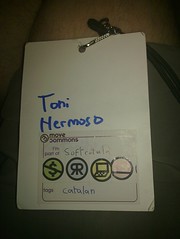
As Barcelona Laptop Orchestra, another nice initiative present in Angels Hacking space during Drumbeat Festival was Move Commons.
Following the graphical model of Creative Commons logos, it pretends to categorise the principles behind organisations in order to provide a simplified description of them, make them visible to other organisations of similar approaches and also attract contributors who could be interested in their activities. With Move Commons, they can currently state whether they are:
As with Creative Commons, after filling the appropriate fields asking for the characteristics of the organisation, they can paste in their pages a FOAF-like code, which could potentially be used for performing searches over the Net in the future.
The only drawback I can imagine is that organisations, or individuals in their organisations, might not be always sincere (or even aware) about their actual values. So, I think the challenge is that the details of organisations we could find in the Internet thanks to this system can be faithful enough about them, that is, not susceptible to purposeful or unintentional misleads —a fact that can entail frustration for arriving contributors—.
This is far more difficult than choosing one of the different CC licenses for a work, and IMHO, several actors should take part somehow in the dynamic outcome.
Last week I enjoyed the chance to discover a laptop orchestra for my first time during Drumbeat Festival 2010, which took place in the centric Plaça dels Àngels of Barcelona.
The orchestra, named Barcelona Laptop Orchestra and mostly composed of members from ESMUC (Catalonia Higher School of Music), was arranged thanks to several laptops network-linked to each other and all of them set to output to a pair of loudspeakers at the same time.
Sounds actually flowed along the network and were differentially modulated in each computer thanks to a complex in-house sampler software designed so a live network-based symphony could become a reality.
You can see some images and videos below:
The software behind the orchestra laptops

Latops are network linked
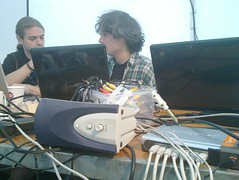
Some live laptop music
More information…
Saturday just after midnight, with a Moka coffee cup next to my right hand, I read in the Web that a festivity is being proposed today for commemorating the birth of one of the most important contemporary Valencian poets in Catalan language: Vicent Andrés Estellés. I must admit that I have not read much from him, apart from his most likely popular poem: Assumiràs la veu d'un poble (roughly translated, You will assume the voice of a people).
Many times you meet interesting people during a congress, but either because you are in a rush or because of social shyness, you may lose the chance to have their contact details —therefore, a possible prolific collaboration would be lost—.
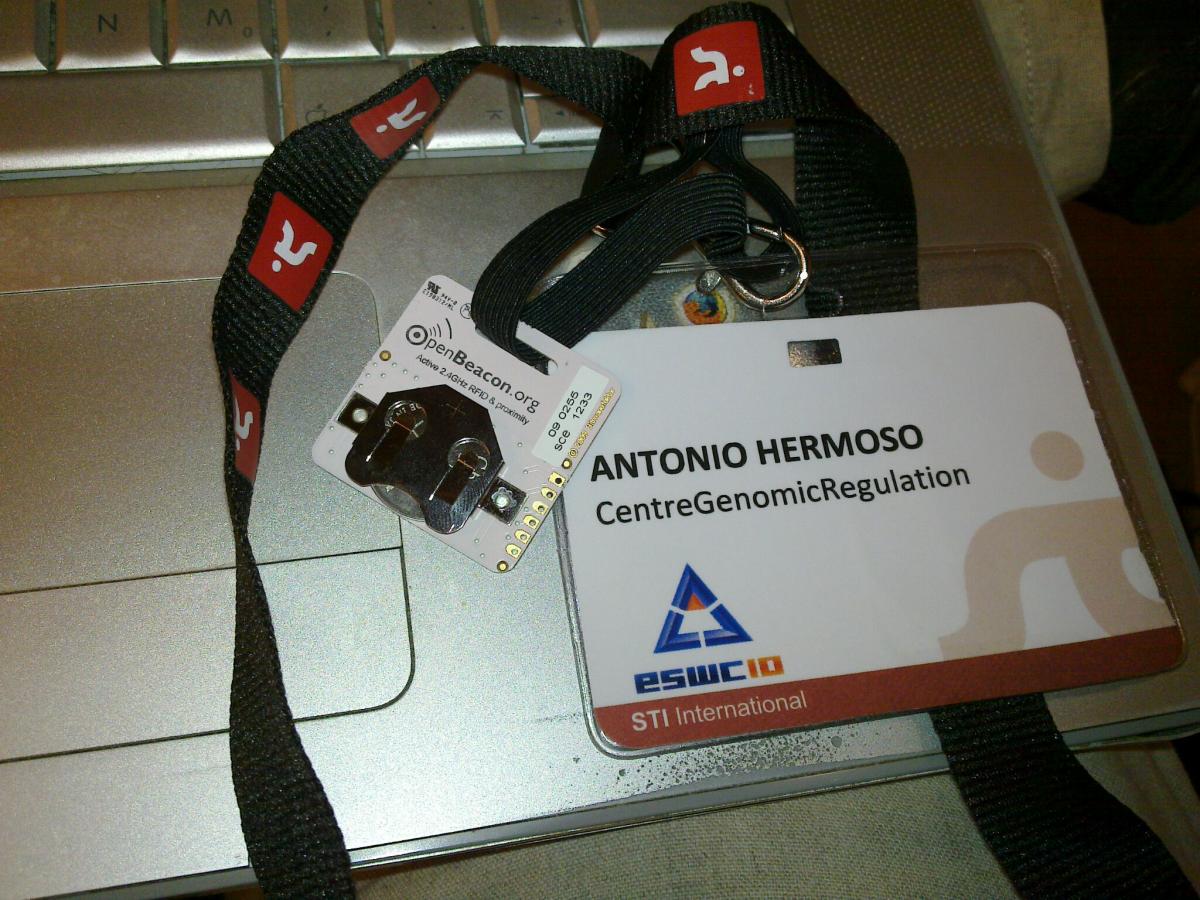
In order to minimize this, in Extended Semantic Web Conference 2010, SocioPatterns project is offering a RFID chip so people who desire to take part in the experience can easily identify their interlocutors in the Web. More details here…
This morning I attended a conference of Dr. Lars Jermiin and, in order to illustrate the statistics behind evolutionary models, he introduced to the public a quotation of the former United States Secretary of Defense. I think this deserves a place in our popular cultural imaginary: